Architecture as the substrate of AI
We design and build systems where AI integrates on top of solid architectures, not next to them. The difference decides whether AI provides leverage or introduces chaos. On a well-designed system, an AI agent multiplies team and business capacity. On a poorly-designed one, it multiplies the failures that were already there — only faster and at greater scale.
The popular narrative says generative AI makes architecture less important because the model "fills in" what's missing. Experience with real projects says the opposite. AI is an amplifier: it turns careful architecture into real velocity; it turns careless architecture into exponential debt. Five concrete reasons architecture weighs more, not less, when there's AI in the system.
Reason 1: testability sustains the eval
A continuous eval of an AI agent is a specific testing layer for stochastic components. But it only adds value if the rest of the system is testable. When domain logic is mixed with model calls, HTTP integrations, and SQL queries in the same method, evals can't isolate what's failing: the model, the integration, the data, or the business rule.
Systems with clear separation — pure domain, ports, adapters — let deterministic tests validate business logic while evals validate model behavior. Each layer has its metric, each failure gets located at its origin.
Without this architecture, "the agent isn't working well" becomes an hours-long conversation without diagnosis. With this architecture, in fifteen minutes the team knows whether the problem is retrieval, model decision, or tool execution.
Reason 2: observability isn't added at the end
Systems with AI produce more events per unit of time and more types of event than traditional systems: every inference, every tool call, every decision, every reasoning step. Without an observability layer designed as part of the architecture, logs become useless within weeks — too much volume, no structure, no cross-cutting traceability.
The right architecture injects observability as a domain port: every agent decision gets recorded from the logic, not from a generic middleware. With OpenTelemetry consolidating traces and a dashboard that crosses model, tool call, and result, incidents get diagnosed in minutes.
In projects that start without this discipline, the team discovers at three months that it can't reconstruct why the agent made a specific decision. That turns any incident into an excuse, not a correction.
Reason 3: change isolation protects the investment
AI providers move models every few months. MCP tool descriptions change. Regulatory norms evolve. If every external change forces touching the system's business logic, the initial investment never finishes amortizing.
A layered architecture — hexagonal, ports & adapters, or clean architecture — turns every external change into a bounded change: an adapter, a configuration, a schema. The domain logic stays intact. Migrating from Claude 4.x to an open-weights model when regulation demands it gets done in five days, not five months.
Without this architecture, every model migration is a project in itself, with impact analysis, unpredictable regressions, and weeks of QA. The operational difference between the two postures is an order of magnitude.
Reason 4: domain integrity prevents contagious hallucinations
When an AI agent acts on a system whose entities aren't well modeled — "customer" means different things in the CRM, the ERP, and the data warehouse — the agent combines those semantics incorrectly. It queries the CRM with the ERP's nomenclature. It assumes "deal" is the same as "purchase order". It decides on concepts that don't exist as stated.
A well-modeled domain, with explicit bounded contexts and ubiquitous vocabulary, makes it clear which entity lives in which context and what translations apply when they cross. The agent receives clean contracts, not ambiguous data. The quality of model decisions depends directly on the quality of the data model it reasons over.
This isn't new in DDD. What's new is that an agent can now act on the system, and errors get executed in production instead of staying as an incorrect SQL query a human retracts.
Reason 5: resilience prevents an LLM failure from killing the system
AI providers have outages, rate limits, variable latencies, and unexpected responses. Without resilience patterns — timeouts, circuit breakers, fallbacks, graceful degradation — an AI agent turns any provider hiccup into a product outage.
The right architecture has resilience as a first-class citizen: every external port call has a configured timeout, every adapter has a retry policy, every critical operation has a defined fallback. When Anthropic returns 503, the agent receives it as Result.degraded(), and the policy of what to do then lives in the domain: retry, escalate to human, return degraded response, abort.
Systems without this discipline depend on the LLM never failing. And the LLM will fail.
How the lack of architecture shows up on the invoice
Three concrete symptoms we see in clients who have added AI on top of poorly-architected code:
Per-query cost nobody can attribute. The system spends ten times more on tokens than expected, but nobody can say which queries are expensive and why. Without structured observability, that question has no answer. Optimizing blind doesn't work.
Unpredictable regressions. Every change in the prompt or the model produces failures in cases that used to work. Without separated domain tests and model evals, the team can't tell which part broke. Releases slow down until they become monthly.
Team stuck in operations. 60-70% of the team's time goes to firefighting integrations, not delivering functionality. Each release introduces more failure surface. Feature delivery velocity falls quarter over quarter.
How the right architecture leverages AI
In projects where we apply clean / hexagonal / DDD architecture from the start and later incorporate AI, the patterns we see are consistent:
Investment in architecture amortizes faster. Designing ports, separating domain from adapters, modeling bounded contexts — all that pays off on projects without AI, and pays double when AI arrives. Every hour invested in architecture translates into iteration speed when agents are in the system.
Junior teams can contribute sooner. In well-architected systems, a junior profile contributes to the domain without touching integrations. AI, with the right guidance, accelerates that onboarding even more. The system scales with the team, not against it.
Business decisions get executed faster. When the domain is clear, changing a business rule is a localized modification. When done with an agent, the modification is a change in the agent's domain prompt. Delivery timelines get measured in days, not sprints.
Three architectural patterns that deliver the most with AI
Without order of preference, the three patterns that have delivered the most on our clients with systems that include AI agents:
Hexagonal / Ports & Adapters. Isolates the agent's domain from LLM providers, concrete tools, and external integrations. Allows model change without domain cost.
DDD with explicit bounded contexts. Models business semantics so the agent acts on consistent concepts. Reduces contagious hallucinations from data ambiguity.
Event-driven on critical operations. Turns every important action into an auditable event. Traceability emerges from architecture, not invented at the end.
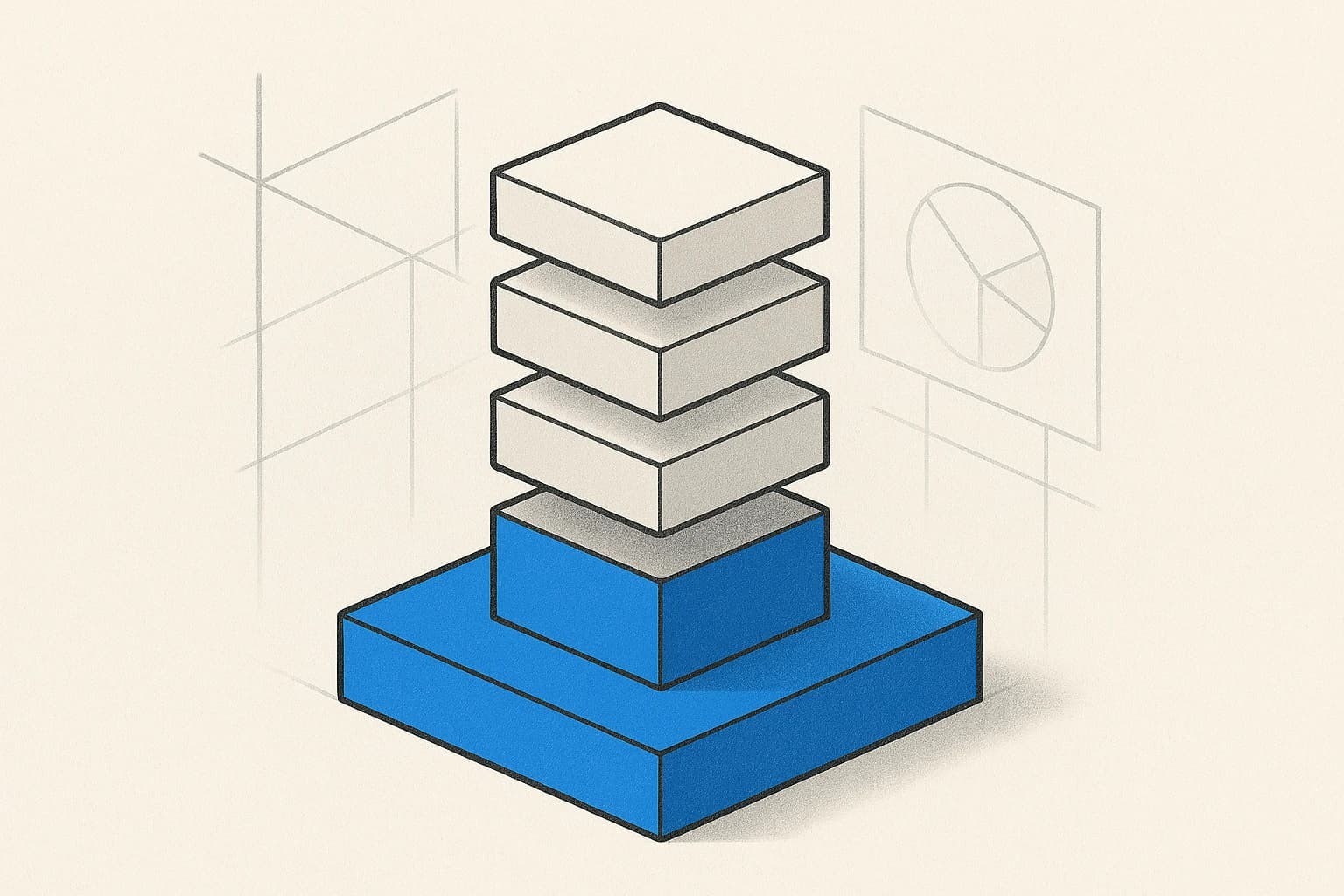
These three patterns work together. Hexagonal protects model change; DDD protects decision integrity; event-driven protects audit.
How we build it in production
In serious projects combining software engineering and AI, the architecture gets decided before the model, before the agent framework, and before the provider. On top of the map of the client's domain, we define bounded contexts, agent ports, resilience criteria, and observability discipline. Only then do the decisions of model, RAG, tools, and guardrails enter.
The result is visible at three months, not three days. At three months, the system handles model changes without trauma, the evals run after every commit, incidents get diagnosed in minutes. The initial investment looks high when signed; stops looking high at the first external change the system absorbs without drama.
Behind each of these systems is a team of engineers who believe AI applied to enterprise starts with a layer that isn't seen — the architecture — and that any visible piece built on top either stands or falls on it. Solid systems first, AI on top. In production, not in demo.
If you're incorporating AI into a system whose architecture level you're not sure you can defend, we can audit the technical base and hand you the roadmap so AI delivers leverage instead of amplifying debt.