What is agentic AI?
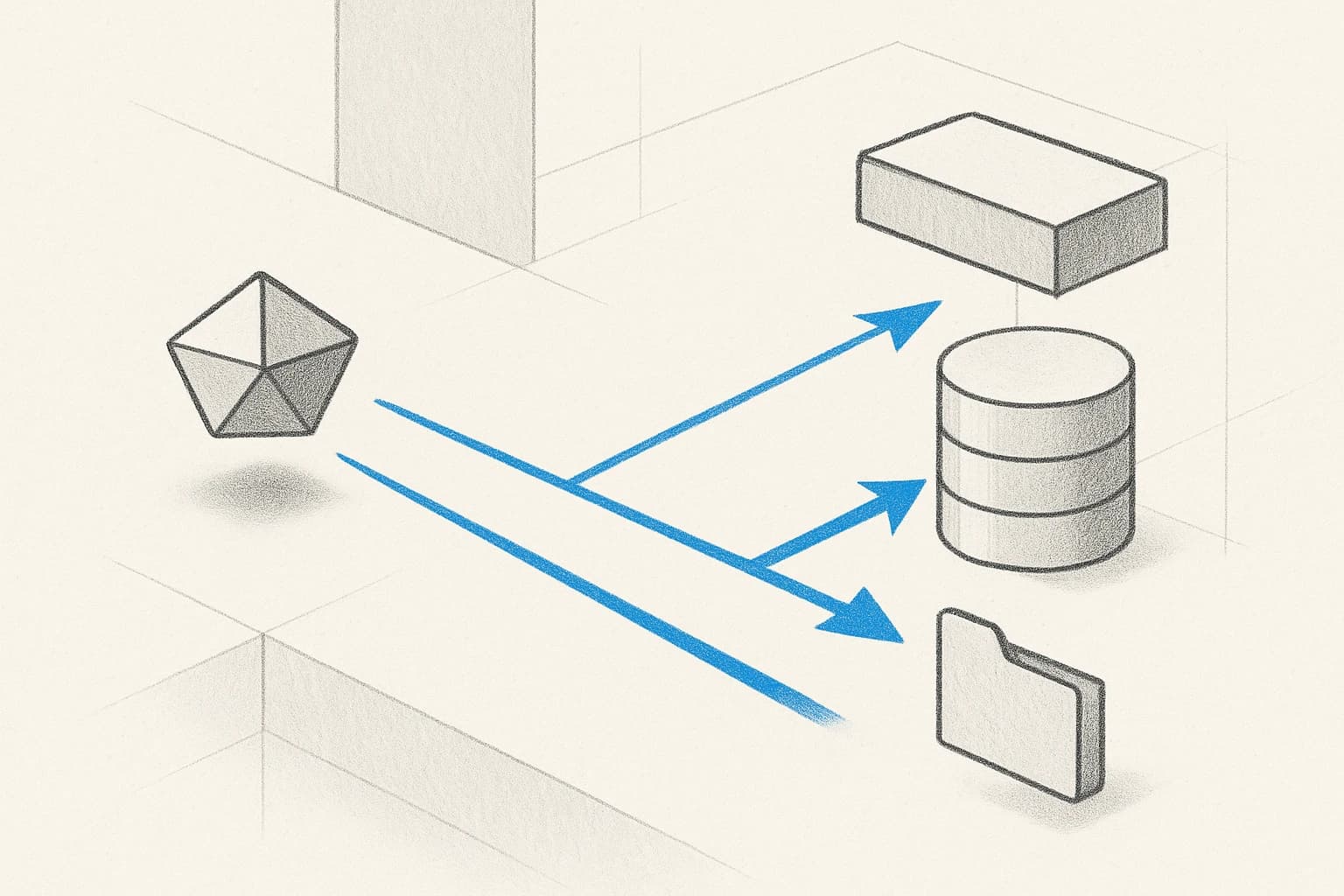
Agentic AI represents a qualitative leap beyond the generative AI that ChatGPT popularized in 2023. While a generative model responds to a prompt and stops, an AI agent is capable of:
- Planning a sequence of steps to achieve an objective.
- Executing actions on real systems (databases, APIs, internal tools).
- Observing results and adjusting its strategy based on outcomes.
- Making intermediate decisions without constant human intervention.
In other words, an AI agent does not just generate text: it acts. It can investigate a problem, consult multiple sources, execute code, interact with external tools, and deliver a complete result, all autonomously within the boundaries it has been given.
Generative AI vs agentic AI
| Aspect | Generative AI | Agentic AI | |---|---|---| | Mode of operation | Prompt → Response | Goal → Plan → Execution → Result | | Autonomy | None (responds and stops) | High (acts independently) | | System interaction | Text/image only | APIs, databases, tools | | Memory | Limited to context window | Persistent across sessions | | Error handling | No (user corrects) | Yes (retries, seeks alternatives) | | Example | "Draft a follow-up email" | "Manage follow-up for the 50 leads that didn't respond this week" |
Real enterprise use cases
Agentic AI is not science fiction. In 2026, companies of all sizes are deploying agents to automate processes that previously required complex manual coordination.
1. Tier 2 and tier 3 customer support
Traditional chatbots handle FAQs. An AI agent goes much further:
- Accesses the customer's complete history in the CRM.
- Checks order status in the ERP.
- Executes corrective actions (refunds, address changes, shipment rescheduling).
- Escalates to a human agent only when the situation demands it, providing a full context summary.
Typical result: 40-60% reduction in ticket volume reaching human agents, with equal or higher customer satisfaction.
2. Financial process automation
Finance departments handle enormous volumes of documents governed by complex rules. AI agents can:
- Extract data from invoices in any format (PDF, image, XML).
- Validate against existing contracts and purchase orders.
- Detect discrepancies and automatically request clarification from suppliers.
- Book validated invoices and generate the corresponding journal entries.
- Prepare exception reports for human review.
3. Intelligent sales pipeline management
A commercial AI agent can operate like a tireless SDR (Sales Development Representative):
- Monitors buying intent signals across multiple channels.
- Enriches leads with data from public and private sources.
- Personalizes and sends communication sequences tailored to each lead's profile.
- Schedules qualification meetings when it detects genuine interest.
- Updates the CRM with every interaction, keeping the pipeline current.
4. Internal employee assistants
Employees spend an average of 2.5 hours per day searching for information and navigating between tools. An internal agent can:
- Answer policy questions by consulting up-to-date documentation.
- Generate reports by combining data from multiple sources.
- Automate routine requests (time off, access permissions, equipment).
- Facilitate new employee onboarding with personalized guidance.
5. Incident monitoring and response
In operations and DevOps teams, agents can:
- Detect anomalies in metrics and logs in real time.
- Correlate alerts to identify root causes.
- Execute remediation runbooks automatically.
- Generate postmortems with timeline, impact assessment, and corrective actions.
Governance and guardrails: the critical piece
Delegating the ability to act to an AI system requires rigorous controls. Governance is not a brake on innovation; it is what makes sustainable innovation possible.
Fundamental principles
Principle of least privilege. An agent should only have access to the systems and data it needs for its specific task. A customer support agent does not need access to financial systems.
Human approval for critical actions. Agents should operate with different levels of autonomy. Low-risk actions (querying information, generating drafts) can be automatic. High-impact actions (refunds above a certain threshold, contract modifications) should require human approval.
Complete traceability. Every agent action must be logged: what it did, why it did it, what data it consulted, and what result it produced. This is essential for auditing, debugging, and continuous improvement.
Continuous testing and evaluation. Agents must undergo periodic evaluations with test cases covering normal scenarios, edge cases, and adversarial situations.
Autonomy level framework
A practical approach is to define progressive autonomy levels:
- Observer: the agent analyzes and suggests but does not act.
- Assistant: the agent prepares actions that a human approves before execution.
- Supervised autonomous: the agent acts independently, but a human reviews periodically.
- Fully autonomous: the agent operates without direct supervision in a well-defined scope.
Most enterprise implementations in 2026 sit at levels 2 and 3. Level 4 is reserved for highly mature processes with high volume and low risk.
How to get started: a practical roadmap
Step 1: Identify the right use case
Do not start with the most complex process in the organization. Look for a case that meets these conditions:
- High volume and repetitiveness: many similar executions per day.
- Clear rules: the decision logic is well-defined.
- Low error risk: failures are correctable and not catastrophic.
- Accessible data: the necessary information is available via API or database.
Step 2: Build a scoped prototype
Develop an agent that resolves 80% of the cases in the chosen process. Do not try to cover 100% from the start. The remaining 20% is handled through human escalation while the system matures.
Step 3: Measure and adjust
Define clear metrics from day one:
- Autonomous resolution rate: percentage of cases the agent resolves without intervention.
- Accuracy: percentage of correct actions out of the total.
- Mean resolution time: compared to the previous manual process.
- User satisfaction: measured through surveys or NPS.
Step 4: Scale with confidence
Once the first use case is validated, apply the learnings to progressively more complex processes. Each iteration refines the infrastructure, guardrails, and team practices.
The role of a technology partner
Implementing agentic AI is not installing a plugin. It requires combining deep knowledge of software engineering, systems architecture, prompt design, model evaluation, and above all, business understanding.
At Dinacode, we work with companies that want to move from AI experimentation to production deployment. Our approach combines technical pragmatism with governance rigor, because we know that an agent that works but cannot be controlled is not a solution: it is a risk.
If you are evaluating how agentic AI can transform processes in your organization, we can help you identify the highest-impact use cases and build an implementation that scales safely.